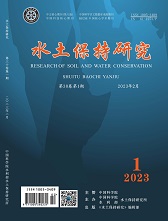
[1]Sun Xiao,Wang Shuai,Lyu Xizhi.Effect of grass cover on rill erosion morphology on loess slopes using terrain scanning technology[J].Research of Soil and Water Conservation,2025,32(06):11-20.[doi:10.13869/j.cnki.rswc.2025.06.006]
Copy
Effect of grass cover on rill erosion morphology on loess slopes using terrain scanning technology
Research of Soil and Water Conservation[ISSN 1005-3409/CN 61-1272/P] Volume:
32
Number of periods:
2025 06
Page number:
11-20
Column:
Public date:
2025-10-20
- Title:
- Effect of grass cover on rill erosion morphology on loess slopes using terrain scanning technology
- Keywords:
- loess slopes; grass cover patterns; erosion rate; rill morphological parameters; 3D laser scanning technology; GIS technology
- CLC:
- S157.1
- DOI:
- 10.13869/j.cnki.rswc.2025.06.006
- Abstract:
- [Objective] The development of rill morphology directly reflects slope erosion severity. This study aims to explore the effects of grass cover patterns on slope erosion and its morphological parameters, providing a scientific basis for the prevention and control of slope erosion on the Loess Plateau. [Methods] In this study, the effects of different grass cover patterns on rill morphology development on loess slopes were examined through artificial rainfall simulation, 3D laser scanning, and geographic information system (GIS) technology. Additionally, the effects of rainfall intensity, slope gradient, and grass cover patterns on rill morphological parameters were analyzed. [Results] (1) Grass cover patterns significantly inhibited both runoff and sediment yield on slopes, with its inhibitory effects on erosion rate being more pronounced than on runoff rate.(2) With increasing grass coverage, rill density, dissection index, and fractal dimension all decreased, while the width-todepth ratio first decreased and then increased, indicating a threshold affecting slope erosion within the 30%~40% coverage range.(3) The effect of grass coverage on rill erosion and morphological parameters was stronger than that of rainfall intensity and slope gradient. (4) The model incorporating rainfall intensity, slope, and grass coverage demonstrated the highest accuracy in simulating their effects on rill density, with a coefficient of determination (R2) of 0.684 and a Nash-Sutcliffe efficiency (NSE) of 0.646, indicating reliable prediction performance. [Conclusion] Grass cover can effectively reduce slope erosion severity and decrease the complexity and density of rill development. Among morphological parameters, rill density and dissection index serve as reliable indicators of rill erosion.
- References:
-
[1]傅伯杰,陈利顶,马克明.黄土丘陵区小流域土地利用变化对生态环境的影响:以延安市羊圈沟流域为例[J]. 地理学报,1999,54(3):241-246. Fu B J,Chen L D,Ma K M.The effect of land use chang on the regional environment in the Yangjuangou catchment in the Loess Plateau of China[J]. Acta Geographica Sinica,1999,54(3):241-246.
[2]Pan C Z,Shangguan Z P.Runoff hydraulic characteristics and sediment generation in sloped grassplots under simulated rainfall conditions[J]. Journal of Hydrology,2006,331(1/2):178-185.
[3]Bai L L,Shi P,Li Z B,et al.Grass coverage and the runoff path length decreased by sedimentation have synergistic effects on runoff and sediment yields in a slopegully system,revealed by rainfall simulation experiments [J]. Catena,2022,218:106577.
[4]Chen H,Zhang X P,Abla M,et al.Effects of vegetation and rainfall types on surface runoff and soil erosion on steep slopes on the Loess Plateau,China[J]. Catena,2018,170:141-149.
[5]Kimaro D N,Poesen J,Msanya B M,et al.Magnitude of soil erosion on the northern slope of the Uluguru Mountains,Tanzania:Interrill and rill erosion[J]. Catena,2008,75(1):38-44.
[6]郑粉莉.黄土区坡耕地细沟间侵蚀和细沟侵蚀的研究[J]. 土壤学报,1998,35(1):95-103. Zheng F L.Study on interrill erosion and rill erosion on slope farmland of loess area[J]. Acta Pedologica Sinica,1998,35(1):95-103.
[7]张攀,姚文艺,肖培青.黄土坡面细沟形态及其量化参数特征[J]. 水土保持通报,2014,34(5):15-17,24. Zhang P,Yao W Y,Xiao P Q.Morphological development of rill and its quantitative morphological parameters characteristics in loess hillslope[J]. Bulletin of Soil and Water Conservation,2014,34(5):15-17,24.
[8]Ou X J,Hu Y X,Li X W,et al.Advancements and challenges in rill formation,morphology,measurement and modeling[J]. Catena,2021,196:104932.
[9]Milan D J,Heritage G L,Hetherington D.Application of a 3D laser scanner in the assessment of erosion and deposition volumes and channel change in a proglacial river[J]. Earth Surface Processes and Landforms,2007,32(11):1657-1674.
[10]Yao Z H,Yang J C,Zhang P,et al.The response mechanisms of topographic changes in small loess watershed under rainstorm[J]. Sustainability,2022,14(17): 10472.
[11]Yermolaev O P,Gafurov A M,Usmanov B M.Evaluation of erosion intensity and dynamics using terrestrial laser scanning[J]. Eurasian Soil Science,2018,51(7): 814-826.
[12]沈海鸥,郑粉莉,温磊磊,等.黄土坡面细沟侵蚀形态试验[J]. 生态学报,2014,34(19):5514-5521. Shen H O,Zheng F L,Wen L L,et al.An experimental study on rill morphology at loess hillslope[J]. Acta Ecologica Sinica,2014,34(19):5514-5521.
[13]Shen H O,Zheng F L,Wen L L,et al.An experimental study of rill erosion and morphology[J]. Geomorphology,2015,231:193-201.
[14]Bruno C,Di Stefano C,Ferro V.Field investigation on rilling in the experimental Sparacia area,South Italy[J]. Earth Surface Processes and Landforms,2008,33(2): 263-279.
[15]He J J,Sun L Y,Duan G Y,et al.Slope gradient impacts on rill morphological characteristics:Using indoor simulation experiment on loamy clay under certain rainfall intensity[J]. Catena,2023,222:106895.
[16]沈海鸥,郑粉莉,温磊磊,等.降雨强度和坡度对细沟形态特征的综合影响[J]. 农业机械学报,2015,46(7):162-170. Shen H O,Zheng F L,Wen L L,et al.Effects of rainfall intensity and slope gradient on rill morphological characteristics[J]. Transactions of the Chinese Society for Agricultural Machinery,2015,46(7):162-170.
[17]Guo M M,Yang B,Wang W L,et al.Distribution,morphology and influencing factors of rills under extreme rainfall conditions in main land uses on the Loess Plateau of China[J]. Geomorphology,2019,345:106847.
[18]张攀,姚文艺,陈伟.降雨驱动下黄土坡面细沟的分形和熵量化描述[J]. 中国水土保持科学,2014,12(5):17-22. Zhang P,Yao W Y,Chen W.Quantitative description of rill morphology on the rainfall-driven loess hillslope by fractal and entropy[J]. Science of Soil and Water Conservation,2014,12(5):17-22.
[19]王占礼,焦菊英.黄土高原长历时土壤侵蚀暴雨标准初探[J]. 水土保持通报,1992,12(3):25-28. Wang Z L,Jiao J Y.A preliminary discussion on the criterion of long duration rainstorm for soil erosion in the Loess Plateau[J]. Bulletin of Soil and Water Conservation,1992,12(3):25-28.
[20]张攀,姚文艺,唐洪武,等.模拟降雨条件下坡面细沟形态演变与量化方法[J]. 水科学进展,2015,26(1):51-58. Zhang P,Yao W Y,Tang H W,et al.Evolution and quantization methods of rill morphology on the slope under rainfall simulation[J]. Advances in Water Science,2015,26(1):51-58.
[21]王帅.典型黄土丘陵区坡面植被—土壤侵蚀动力过程耦合作用机制[D]. 河南:郑州大学,2024. Wang S.Mechanism of coupled vegetation-soil erosion dynamics on slopes in typical loess hilly areas[D]. Zhengzhou:Zhengzhou University,2024.
[22]Fujiwara T,Fukada M,Study on the fractal dimension of rill patterns that develop on hillslope[J]. International Workshop on Conservation Farming on Hillslopes,1989,1(2):1-13.
[23]蔡强国.坡面细沟发生临界条件研究[J]. 泥沙研究,1998,23(1):52-59. Cai Q G.Research of rill initiation condition on loess hillslopes[J]. Journal of Sediment Research,1998,23 (1):52-59.
[24]沈海鸥.黄土坡面细沟发育与形态特征研究[D]. 陕西杨凌:西北农林科技大学,2015. Shen H O.Rill development and its morphological characteristics at loess hillslope[D]. Yangling,Shaanxi: Northwest A&F University,2015.
[25]李君兰,蔡强国,孙莉英,等.坡面水流速度与坡面含砂量的关系[J]. 农业工程学报,2011,27(3):73-78. Li J L,Cai Q G,Sun L Y,et al.Relationship between the spatial distribution of flow velocity and sediment concentration[J]. Transactions of the Chinese Society of Agricultural Engineering,2011,27(3):73-78.
[26]崔志强,王文龙,郭明明,等.不同植被措施下排土场边坡细沟发育时空特征[J]. 土壤学报,2020,57(5):1155-1165. Cui Z Q,Wang W L,Guo M M,et al.Spatial and temporal characteristics of rill development on slopes of waste dump of mining as affected by revegetation measures[J]. Acta Pedologica Sinica,2020,57(5):1155-1165.
[27]史倩华,王文龙,刘瑞顺,等.植被恢复措施对不同排土年限煤矿排土场边坡细沟侵蚀的影响[J]. 农业工程学报,2016,32(17):226-232. Shi Q H,Wang W L,Liu R S,et al.Effect of vegetation recovery measures on rill erosion of dump side slope in coal mine with different casting time[J]. Transactions of the Chinese Society of Agricultural Engineering,2016,32(17):226-232.
[28]麻力文,陈晓燕,陶婷婷,等.不同降雨强度及坡度条件下饱和紫色土坡面细沟形态特征[J]. 水土保持学报,2023,37(1):77-83. Ma L W,Chen X Y,Tao T T,et al.Morphological characteristics of rills on the slope surface of saturated purple soil under different rainfall intensities and slopes [J]. Journal of Soil and Water Conservation,2023,37 (1):77-83.
[29]牛耀彬,高照良,李永红,等.工程堆积体坡面细沟形态发育及其与产流产沙量的关系[J]. 农业工程学报,2016,32(19):154-161. Niu Y B,Gao Z L,Li Y H,et al.Rill morphology development of engineering accumulation and its relationship with runoff and sediment[J]. Transactions of the Chinese Society of Agricultural Engineering,2016,32(19):154-161.
[30]Zhang B J,Zhang G H,Yang H Y,et al.Soil resistance to flowing water erosion of seven typical plant communities on steep gully slopes on the Loess Plateau of China[J]. Catena,2019,173:375-383.
- Similar References:
Memo
-
Last Update:
2025-12-10